
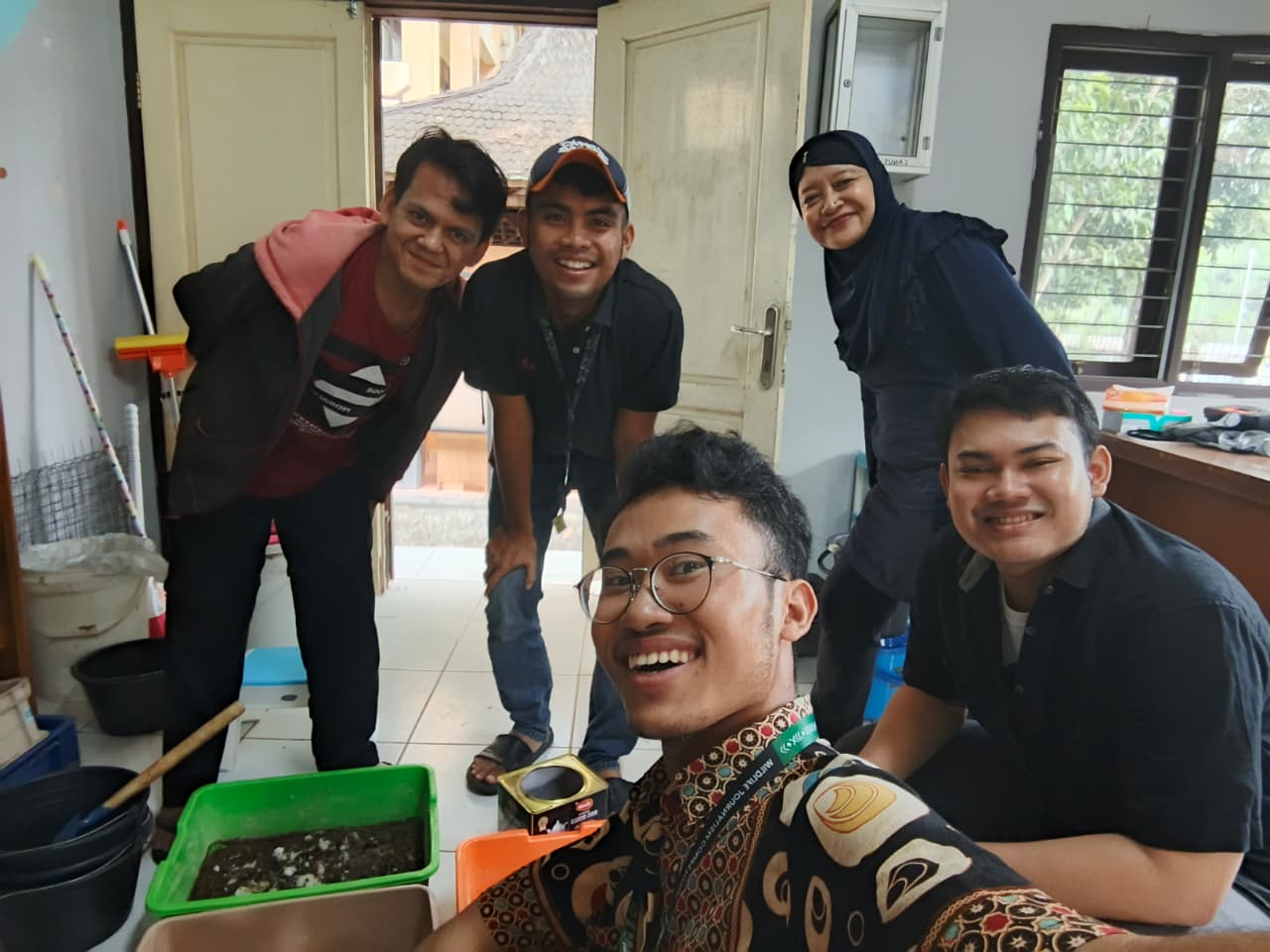
Maggot Farm for Waste Management: Fikom Unpad’s Commitment to a Greener, More Sustainable Campus
In support of Universitas Padjadjaran’s Green Campus vision, the Faculty of Communication Sciences has initiated a forward-thinking environmental program through the creation of a maggot farm. This innovative effort aims to tackle one of the most overlooked yet pressing issues in campus sustainability: food waste. By turning leftover organic waste into a valuable resource, the maggot farm contributes to a circular approach to consumption and waste management.
Reducing Food Waste Through Biological Innovation
Food waste is a major contributor to environmental degradation. In university environments—particularly where student cafeterias, campus events, and daily consumption occur—large volumes of organic waste are often discarded without being properly processed. Left untreated, this waste not only contributes to landfill overflow and methane emissions, but also represents a significant loss of resources.
To address this issue, the Faculty of Communication Sciences established a maggot farm, using the larvae of the Black Soldier Fly (Hermetia illucens) to break down and convert organic waste into usable biomass. Maggots can consume large quantities of food scraps in a short amount of time, turning what would otherwise be trash into high-quality compost and protein-rich feed for fish or poultry.
This biological approach to waste management is not only efficient but also low-cost and scalable, making it a perfect solution for educational institutions seeking sustainable waste management systems.
Supporting a Green Campus Movement
The maggot farm project is part of a broader movement within Universitas Padjadjaran to develop environmentally responsible and ecologically aware campus practices. Fikom’s initiative embodies the principles of a Green Campus, where sustainability is not merely a slogan, but a lived, collective commitment integrated into the academic, operational, and cultural aspects of university life.
This initiative reflects the faculty’s growing role not only as a center for education and research but also as an agent of change, actively encouraging students and staff to think critically and act responsibly regarding environmental issues.
Educating for Sustainability
Beyond its ecological benefits, the maggot farm serves as a learning tool. It introduces students to real-world applications of sustainability, composting, and circular economy practices. It also presents opportunities for research, community engagement, and cross-disciplinary collaboration between communication studies, environmental science, and agricultural technology.
By turning the campus into a living laboratory, the Faculty empowers students to become part of the solution—developing not only environmental literacy but also a deeper sense of civic responsibility.
Aligning with the SDGs
This initiative directly supports Sustainable Development Goal (SDG) No. 12: Responsible Consumption and Production, which emphasizes reducing food waste at all stages—especially at the consumption level. By converting food waste into valuable by-products, the Faculty is taking practical action to minimize ecological footprints while contributing to the university’s global sustainability commitments.
Additionally, the maggot farm indirectly supports other goals such as SDG 13 (Climate Action) and SDG 15 (Life on Land) by reducing methane emissions from decomposing food waste and improving soil health through compost. (KA)
#GreenCampus #Maggot #ResponsibleConsumption #UnpadImpactStoriesSDG12


