Research on Public Interest, Interest and Convenience in Television Broadcast Programs
Research on Public Interest, Interest and Convenience in Television Broadcast Programs
The Indonesian Broadcasting Commission (KPI) as the regulator of broadcasting operations needs to have a scientific basis in carrying out its functions and authorities, namely to formulate and supervise various broadcasting regulations that link broadcasting institutions, the government and the public. Therefore, the interests, interests, and comfort (MKK) of the community in watching television broadcast programs are three aspects that must be measured so that diversity of content and diversity of ownership can be maintained. This is as stated in the RI Law no. 32 of 2002 concerning broadcasting, which was updated with article 72 of the Job Creation Law, articles 8 and 52.
The research, which was conducted by KPI in collaboration with Padjadjaran University, was carried out in three urban areas in West Java, namely Bandung, Cirebon and Tasikmalaya, from April to September 2021. The research was conducted on respondents who still watch television, aged over 17 years, most of whom are in the age range of 41-60 years, female, come from Sundanese ethnicity, are Muslim, have an average expenditure of Rp900,000–Rp1,250,000 , graduated from high school, and was dominated by housewives and did not subscribe to cable TV.
The results of the research show that the interest, interest and convenience index (MKK) for the public in West Java is in a medium-high position with an index of 6.83 (with an index range of 1–10). Where the interest category gets the highest index value while the comfort category gets the lowest score. If viewed based on the broadcast program category, the highest public interest, interest, and convenience were obtained by religious broadcasting programs, namely 7.30, while entertainment broadcasting programs obtained the lowest index value, namely 6.57.
This is different from the results of research on the habit of watching television broadcast programs ( media habit ), which shows that information broadcast programs are the most watched broadcast programs by respondents who come from all categories of age, ethnicity, religion, level of expenditure, education, and occupation. respondents. Watching behavior differs only in the gender characteristics of the respondents, where male respondents watch more information broadcast programs (99.25%), while female respondents watch entertainment broadcast programs more (98.19%).
This research also produces data that in addition to watching television, the majority of respondents (89.33%) use online media, with details as many as 80.67% of respondents using social media, 76% of respondents using video streaming , 71.33% of respondents reading online news portals. , and 40% of respondents use streaming audio . As for conventional media, only 37.s67% of respondents still listen to the radio and 32.67% of respondents still read newspapers.
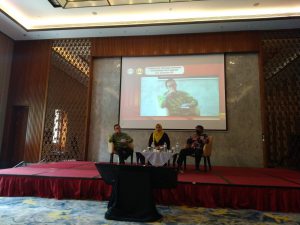
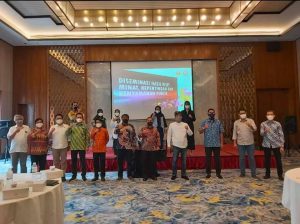
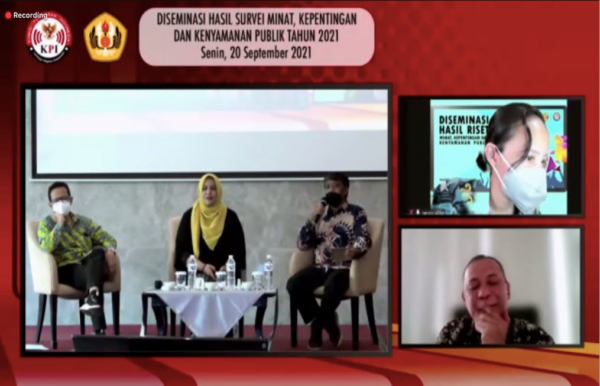
The results of the KPI and Padjadjaran University research were presented at the 2021 public interest, interest and convenience survey activity which was held on Monday, September 20, 2021, starting at 08.30 WIB on a regular basis. hybrids. (RA)