
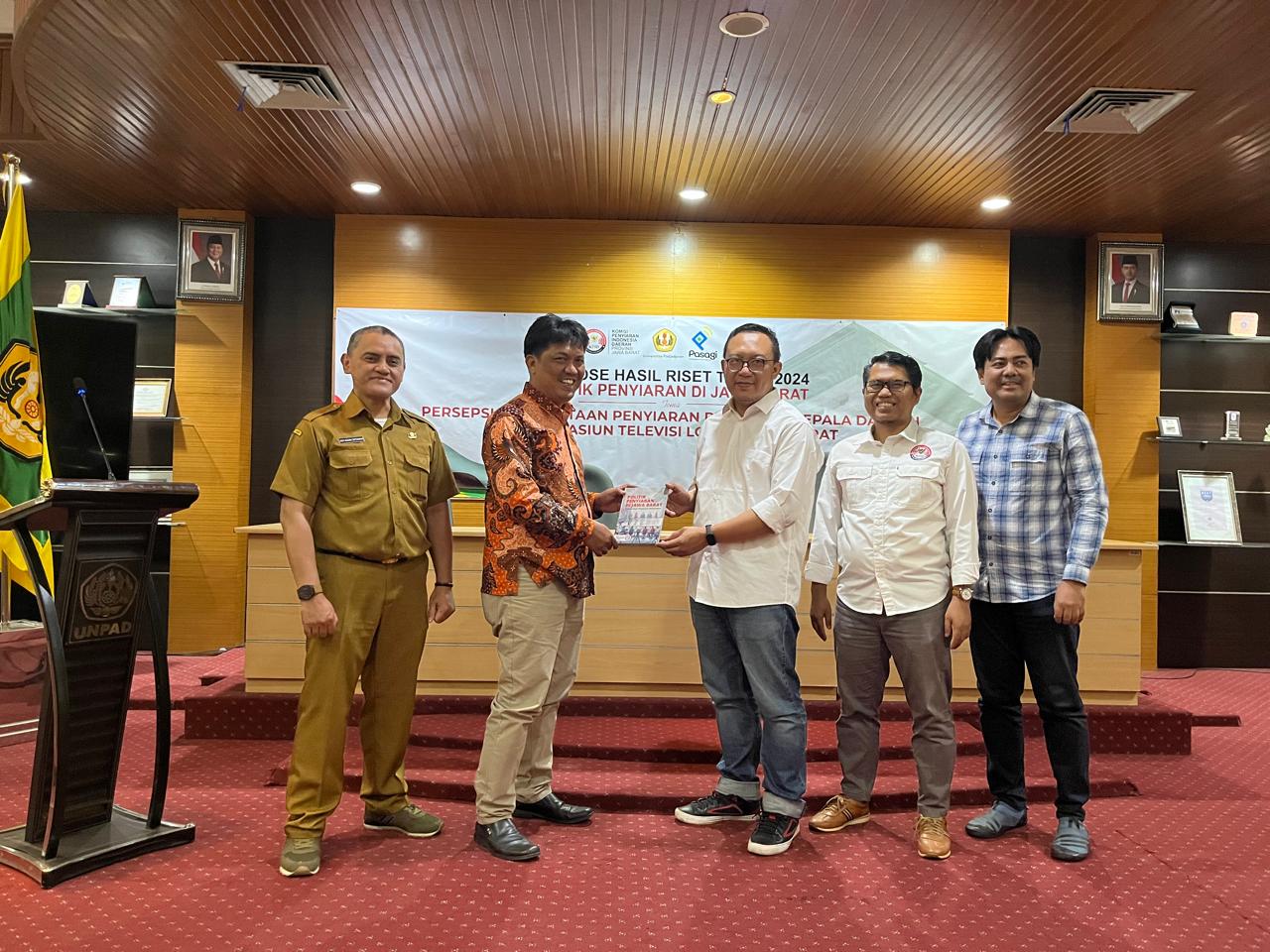
Fikom Unpad and KPID West Java Organized an Expose of Research Results “Perception of Broadcasting News of Regional Elections on Local Television Stations in West Java”
Fikom Unpad and the Regional Indonesian Broadcasting Commission (KPID) of West Java Province held an Expose of Research Results “Perception of Broadcasting News of Regional Elections on West Java Local Television Stations” on Monday, November 25, 2024 at 08.00-11.00 WIB in Oemi Room Fikom Unpad. The event was attended by Fikom Unpad research team, Deputy Chairperson of West Java KPID and team, Public Relations of West Java Communication and Information Office, and Fikom Unpad students. The event was hosted by the sons and daughters of Fikom Unpad Rafi Ahmad Zaidan and Anindita Prameswari.
This activity is the realization of the West Java KPID program related to research access studies. The theme raised is the Perception of Bandung City People About Local Broadcasting Institutions (Local Television Stations) and Broadcast Programs Related to Pilkada on Local Television in West Java Province. The Regional Indonesian Broadcasting Commission (KPID) of West Java Province collaborated with 4 universities, one of which was Padjadjaran University. This collaboration aims to map the public perception of Bandung City towards local broadcasting institutions and broadcast programs related to the elections. It is hoped that the results of this research can provide insight into the role of local television in delivering quality information, as well as its contribution in creating transparent, fair, and well-informed elections.
The event began with an introduction from Dr. Roni Tabroni, S.Sos., M.Si as the Coordinator of the West Java KPID Institutional Division, he said that media instruments support democratic entities, with this research we want to see how the narrative in the broadcast media has an impact on society. Next was a speech from Depi Agung Setiawan, S.Sos., M.Ikom as the Public Relations Officer of the West Java Communication and Information Agency. He said that broadcasting institutions have an important role in Pilkada, namely conveying election information to the public. Furthermore, the Vice Dean for Academic, Student Affairs, Research and Partnerships Prof. Dr. Atwar Bajari, M.Si, said that the dynamics of the media are so fast that the public is led by new information, it is hoped that the media can play a role in helping provide information and education to the public, especially related to regional head elections (pilkada).
Deputy Chairman of KPID Jabar Ahmad Abdul Basith, M.Ikom in his speech said that currently the most trusted media are television, radio, and social media from mainstream media, therefore he urged fellow students to get information from trusted media. Furthermore, he officially opened the Research Results Exposition event “Perception of Broadcasting News of Regional Elections on West Java Local Television Stations”.
The next agenda was the keynote speech from Mr. Rafael Situmorang, Member of Commission I of the West Java Regional House of Representatives. He said that with strong literacy, young people can have political confidence, hopefully broadcasters can foster digital literacy space.
The event continued with the presentation of research results “Perception of Broadcasting News of Regional Elections on Local Television Stations in West Java” by representatives of the Fikom Unpad research team FX. Ari Agung Prastowo, S.Sos., M.I.Kom. This research found several important findings related to the perception of the people of Bandung City towards Pilkada broadcasting on local television, which can be divided into several main sections:
- Local television is still an important source of information for the community, including in the context of election news. The findings show that most respondents access several local television stations such as Indosiar, SCTV, and MNC Jabar, which are the main sources of political information. This reflects the important role of local television as a source of information that can be trusted by the community, especially in the issue of regional elections.
- In general, the public perceived local television quite positively in terms of providing adequate time for election coverage and giving a fair proportion of all candidates participating in the elections. However, there was some variation in ratings regarding the neutrality of local television and its compliance with regulations. Some respondents felt that local television sometimes took sides, or did not always comply with regulations. This suggests that despite positive perceptions of broadcast quality, there is a need to improve the transparency and accountability of local broadcasters in their coverage of local elections.
- Local television programs were considered adequate in providing fair and proportional election coverage for all candidates. However, there were mixed views on whether the programs were biased or frequently violated election regulations. Most people did not see any frequent violations, although there were some who were unsure about this.
- The results of the analysis show that perceptions of the quality of local television programs have a significant effect on the intention to participate in the 2024 local elections. The better the perceived program quality, the higher people’s intention to participate in the elections. In contrast, perceptions of local television broadcasters do not show a significant effect on participation intentions. This indicates that people value the quality of local election broadcast content more than the quality of the broadcaster itself in determining their level of political participation.
Overall, this study confirms the important role of local television in providing fair and quality information about local elections, which can influence people’s political knowledge and participation. However, challenges remain in ensuring that local television remains neutral, complies with existing regulations, and avoids violations that could undermine the integrity of elections. Further research is needed to dig deeper into the level of public understanding of election and broadcasting regulations, as well as more effective socialization efforts from the authorities. The event was closed by handing over books and plaques from KPID West Java to Fikom Unpad, and continued with a group photo session. (RA)
#SDGs16 #PeaceJusticeStrongInstitutions #AccessToInformation #SDGsFikomUnpad
