
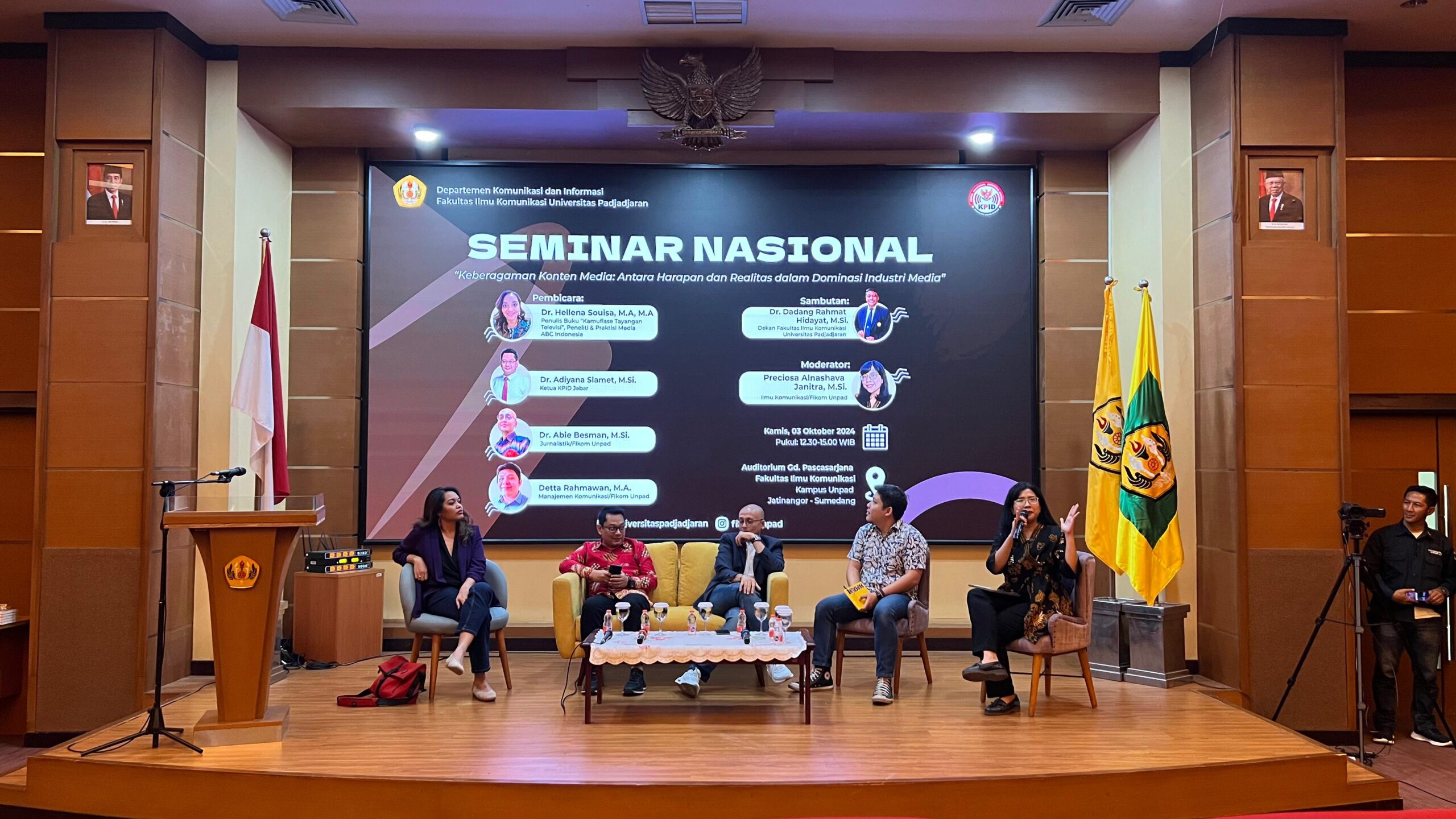
National Seminar on “Media Content Diversity: Between Expectations and Reality in the Dominance of the Media Industry”
The Faculty of Communication Sciences (Fikom) at Padjadjaran University held a national seminar with the theme “Media Content Diversity: Between Expectations and Reality in the Dominance of the Media Industry.” The seminar was held on Thursday, October 3, 2024, at the Postgraduate Auditorium of the Faculty of Communication Sciences, Padjadjaran University, and was broadcast live on the Fikom Unpad Official YouTube channel.
The event began with all participants singing the Indonesian national anthem, Indonesia Raya. Next, the seminar was officially opened with a speech from Dr. Jenny Ratna Suminar, Deputy Dean II of the Faculty of Communication Sciences at Padjadjaran University, who spoke about the importance of understanding media and content in receiving information.
This seminar featured four speakers who, with their expertise, provided deep insights into the broad theme of media content diversity. The speakers presented a variety of topics relevant to media diversity, ranging from the importance of presenting diversity, broadcasting regulations, and communication technology.
Hellena Souisa, Ph.D – Diversity of Content on Television
In her dissertation, Hellena calmly raises the issue of diversity in television content. Hellena also explained the current state of television content in Indonesia. Television entrepreneurs dominate television channels with similar content. Even though there are many television programs available, if they are unable to offer diversity, then these media outlets also need to transform.
Dr. Adiyana – Media Content Regulation
Dr. Adiyana, Chair of the West Java KPID, spoke about the role and function of the KPID, accompanied by a presentation on current television audience data, followed by additional data on Gen-Z viewers who watch programs on TV, OTT, and social media. Challenges faced by KPID West Java as an institution related to regulation also arise. KPID strives to remind local media outlets to promote diversity, but local media outlets still face economic and human resource challenges.
Dr. Abie Besman, M.Si – Television Industry and Content Diversity
Abie Besman said that media and journalism can build public trust, which is also related to how to bring diversity to media content. He also highlighted current developments in the media, particularly television, which can now be said to have undergone a transformation through the media that exists in the digital world. In the digital world, luxury is no longer about rules, but about oneself.
Detta Rahmawan, M.A – Diversity of Content and Public Issues
Detta Rahmawan was the last speaker of the seminar session, discussing public issues. Is it true that virality is the key to the spread of public issues and content diversity? Technology is linked to public issues. Through technology, we can raise awareness of issues that need to be discussed and promote diversity. Homeless media and digital activism are ways to help generate more diverse issues.
After the presentation, a discussion session was opened and moderated by Preciosa Alnashava Janitra, M.Si. The seminar participants enthusiastically asked various questions. Several questions that arise focus on news or information that appears on television or mass media, which is the same information over and over again. Then, with the advent of social media, how can journalism in the media remain ideal and productive? After the discussion, the event was closed by the Head of the Department of Communication and Information, Prof. Eni Maryani, M. Si.
This National Seminar is expected to provide highly relevant and important knowledge and insights on the importance of media content diversity and how all parties can support the implementation of content diversity aimed at providing more useful education and information to the public. (TAH)
#SDGs16 #PeaceJusticeStrongInstitutions #AccessToInformation #SDGsFikomUnpad
