Scientific Oration and Fikom Appreciation, Highlights of the 62nd Anniversary of Fikom Unpad
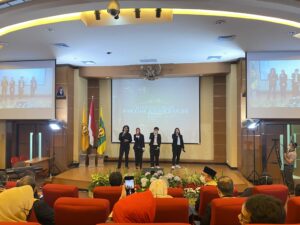
Padjadjaran University’s Faculty of Communication celebrated its 62nd Anniversary on Sunday, September 18, 2022. A series of events were held to commemorate this historic day, as the highlight of the event was the Scientific Oration and Fikom Appreciation on Monday, September 19, 2022 at 08.00 -12.00 WIB. The event which was attended by lecturers, education staff, students, alumni, and invited guests was held hybridly in the Postgraduate Auditorium Room of Fikom Unpad, through zoom meetings, and live on youtube fikom unpad.
The 62nd Anniversary of Fikom Unpad has been held from June 2022 to September 2022. The activities consisted of book launches, communication webinar series, art competitions, sports competitions, grateful Fikom, Fikom Berbagi, blood donation, Scientific Oration, Fikom Appreciation, and closed with a family gathering which will be held on September 24, 2022.
Rector of Universitas Padjadjaran, Prof. Dr. Rina Indiastuti, M.SIE. delivered a speech and congratulated the 62nd Anniversary of Fikom Unpad. He expressed his hopes for Fikom Unpad “We really hope that Fikom Unpad will remain enthusiastic, remain creative in terms of developing science and technology, and communication science will be more useful and global” he said. He also said that we should always be enthusiastic and grateful and keep looking forward as an opportunity and challenge.
Dean of the Faculty of Communication Sciences Universitas Padjadjaran Dr. Dadang Rahmat Hidayat, S.Sos., S.H., M.Si., in his speech said that Fikom Unpad in its 62nd year has undergone various dynamic gait as an integral part of Universitas Padjadjaran. Until now, the Faculty of Communication Sciences, which manages 10 study programs along with 3 departments, continues to carry out institutional optimization and synergy between management units in carrying out their functions. Until this year, study programs within Fikom Unpad still have quite high demand in various student admission selection schemes, where in 2022 there were more than 16,949 prospective students competing for 751 places in all study programs and all levels with a tightness level of 1. 22.5: 22.5. In the series of 62nd Anniversary of the Faculty of Communication Sciences, various activities were held, with the theme “Communication Realizing Joint Awakening”. At the end of his speech, he expressed his gratitude to the 62nd Anniversary committee of Fikom Unpad and various parties who have helped various Fikom Unpad Anniversary activities this year, thanks also go to the seniors who are the predecessors of the leadership, lecturers, and education staff who have contributed their work to the faculty.
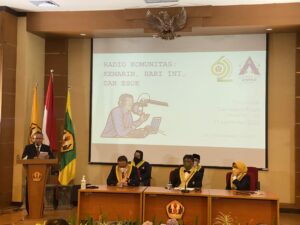
The next event was a scientific oration delivered by Dr. Dian Wardiana Sjuchro, M.Si. with the title “Community Radio: Yesterday, Today and Tomorrow”. In his speech, he conveyed a spark of thought about the existence of Community Radio. Community Radio is actually inseparable from the birth of Law 32/2002 on Broadcasting. Community radio began to be recognized in Indonesia in the decade of the 2000s, community radios in Indonesia were born before the birth of the Broadcasting Law, giving birth to the term dark radio in the radio world. Community radios were born when their existence was not yet recognized by legislation. After the birth of the Broadcasting Law, the life of community radio in Indonesia is very vibrant. Community radio was born in almost all districts/cities in West Java with an astonishing number. From 2002 until the next few years, there was a kind of freedom of information euphoria, which encouraged people to fill the freedom of information with various lively activities. However, since the Broadcasting Law was passed by the House of Representatives, the existence of community radio in Indonesia has been controversial. The existence of community radio is clearly rejected by the majority of broadcasters in Indonesia, especially the existing private radio owners. According to him, the upcoming deliberation of the West Java Community Radio Network members needs to discuss how to face the era of media convergence that is sweeping the communication business, prepare for the development of frequency channels, and open various opportunities for the development of various activities that may be carried out by community radio, for example disaster radio activities, which have received support from donors from Japan. At the end of his speech, he congratulated the academic community who were commemorating the 62nd Anniversary of the Faculty of Communication Sciences, Padjadjaran University.
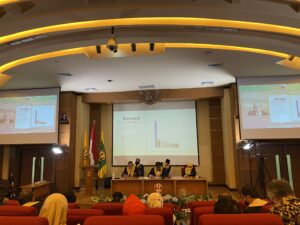
Dr. Aceng Abdullah, M.Si. delivered an oration entitled “Challenges and Opportunities of Communication Science in Corruption Eradication in Indonesia”. He said that corruption in Indonesia seems to have become a culture because corruption occurs at all levels of society, from corruption with a value of trillions of rupiah carried out by high-ranking officials to corruption of small change carried out by small employees at the village level or on the highway in the form of extortion (illegal levies). This corruption has been going on for a long time, since the time of the kings in Java and other parts of Indonesia. That’s why Indonesia has always been positioned as one of the most corrupt countries by a number of international anti-corruption organizations. Despite the ongoing crackdown, corruption does not seem to be abating. Efforts to eradicate corruption in Indonesia have been carried out in various ways, but until now there is still corruption in various ways carried out by various institutions but there are obstacles in eradicating corruption, including obstacles: structural, cultural, instrumental, and management. Communication academics have a great opportunity to participate in the eradication and prevention of corruption in Indonesia which is increasingly massive through the implementation of the Tridharma of Higher Education. At the end of his speech, he said that communication science is not a panacea that can cure various diseases, including eradicating corruption in Indonesia. However, communication science is expected to make an even greater contribution to this corruption eradication effort together with other fields of science.
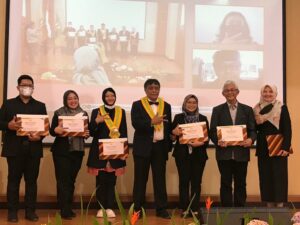
In this Scientific Oration and Fikom Appreciation activity, there was also a book launch of Fikom Unpad academicians and the launch of Divia TV Unpad. The next event was Fikom Appreciation, an appreciation for all Fikom Unpad academicians, lecturers, students, and education staff with various categories, namely retired lecturers and staff, outstanding students, outstanding education staff, outstanding lecturers, lecturers with the most publications, and favorite lecturers from each study program. The event was closed with an acoustic performance from Fikom Unpad students. (DM)